
 EN
EN  AR
AR FR
FR DE
DE EL
EL IT
IT JA
JA KO
KO PT
PT RU
RU ES
ES SV
SV TL
TL ID
ID UK
UK VI
VI TH
TH TR
TR MS
MS UR
UR BN
BN MY
MY KK
KK SI
SI UZ
UZ AM
AM
Small Amphibious All-Terrain Vehicle
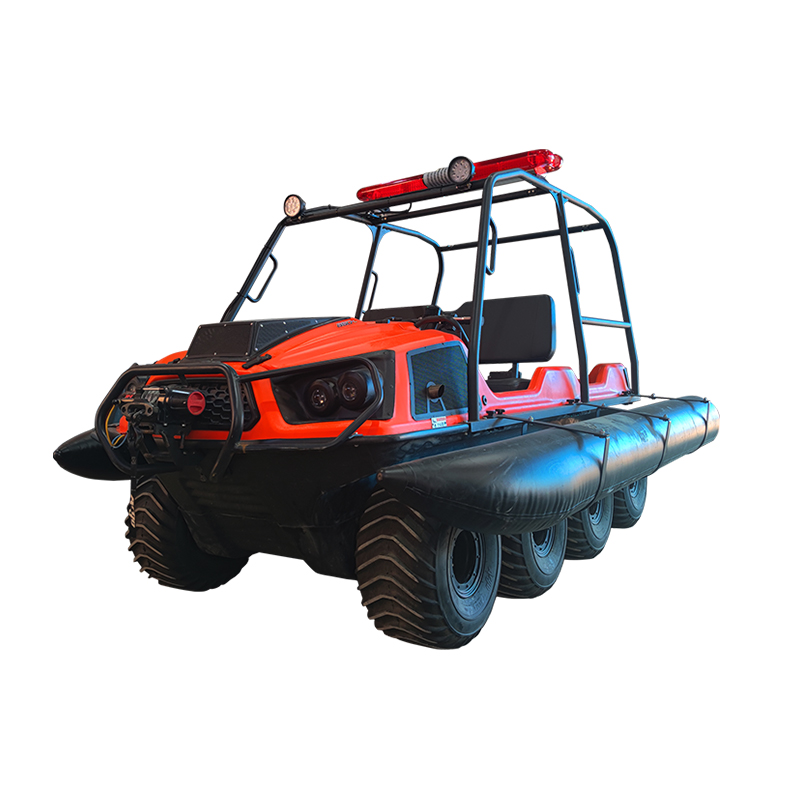
Description
The small amphibious all-terrain vehicle series can travel on land and also float on water, adapting to complex road conditions such as mud/snow, swamps, hills, streams, forests, grasslands, and possessing certain heat resistance and cold resistance capabilities. If operating in waters with high salinity, protective measures for the vehicle's metal components are necessary. In emergency rescue operations, the main function of this vehicle is to enable firefighting and rescue personnel to reach the disaster site under extremely complex terrain in a timely manner, to meet the emergency rescue mission of the "last 1 kilometer, last 5 minutes." It can safely transport injured personnel away, provide materials and life supplies for the disaster area, and also meet the needs of firefighters to carry equipment and equipment over long distances, freeing their hands and saving physical strength. The upper equipment can choose different emergency kits, such as rescue stretchers, searchlights, warning lights, sirens, winches, hooks, etc., to provide the greatest degree of self-safety protection and rescue capability for firefighters in distress.
Product Highlights:
The tires use a unique low-pressure duck web tire, which is designed with a paddle blade that can optimize traction by propelling the vehicle amphibiously through extremely rugged terrain. The tires exert minimal ground pressure, enabling high traction.
Progressive Steering System (APS), this system is an innovation in the application field of braking force in the transmission differential steering. To eliminate the traditional slipping and shaking phenomenon, an elastic mechanism is equipped between the handlebars and the braking system, thus achieving a progressive dual-speed steering system. This steering system allows the vehicle to make a pivot turn, enabling it to turn around in place in narrow spaces, greatly improving the maneuverability of the vehicle. At the same time, it ensures the safety of the vehicle at high speeds and the comfort at low speeds.
The lower vehicle body is made of one-piece high-density polyethylene (HDPE), which has good dielectric properties and is also resistant to environmental stress cracking. It is superior to low-density polyethylene in terms of hardness, tensile strength, and smooth durability of creep deformation. It has good chemical stability, is insoluble in any organic solvents at room temperature, and is resistant to corrosion by acids, alkalis, and various salts; due to its lightweight material, the overall vehicle weight is ≤800kg.
Parameters
| Power System | Continuous Operating Time | ≥60Nm |
| Mobility Capability | High Speed | ≥35km/h |
| Aquatic Speed | ≥5km/h | |
| Beidou System Parameters | Reception Sensitivity | ≤-127.6dBm |
| First Capture Time | ≤2s | |
| Positioning Accuracy | ≤10m | |
| Speed Measurement Accuracy | ≤0.1m/s |

 WhatsApp Directly